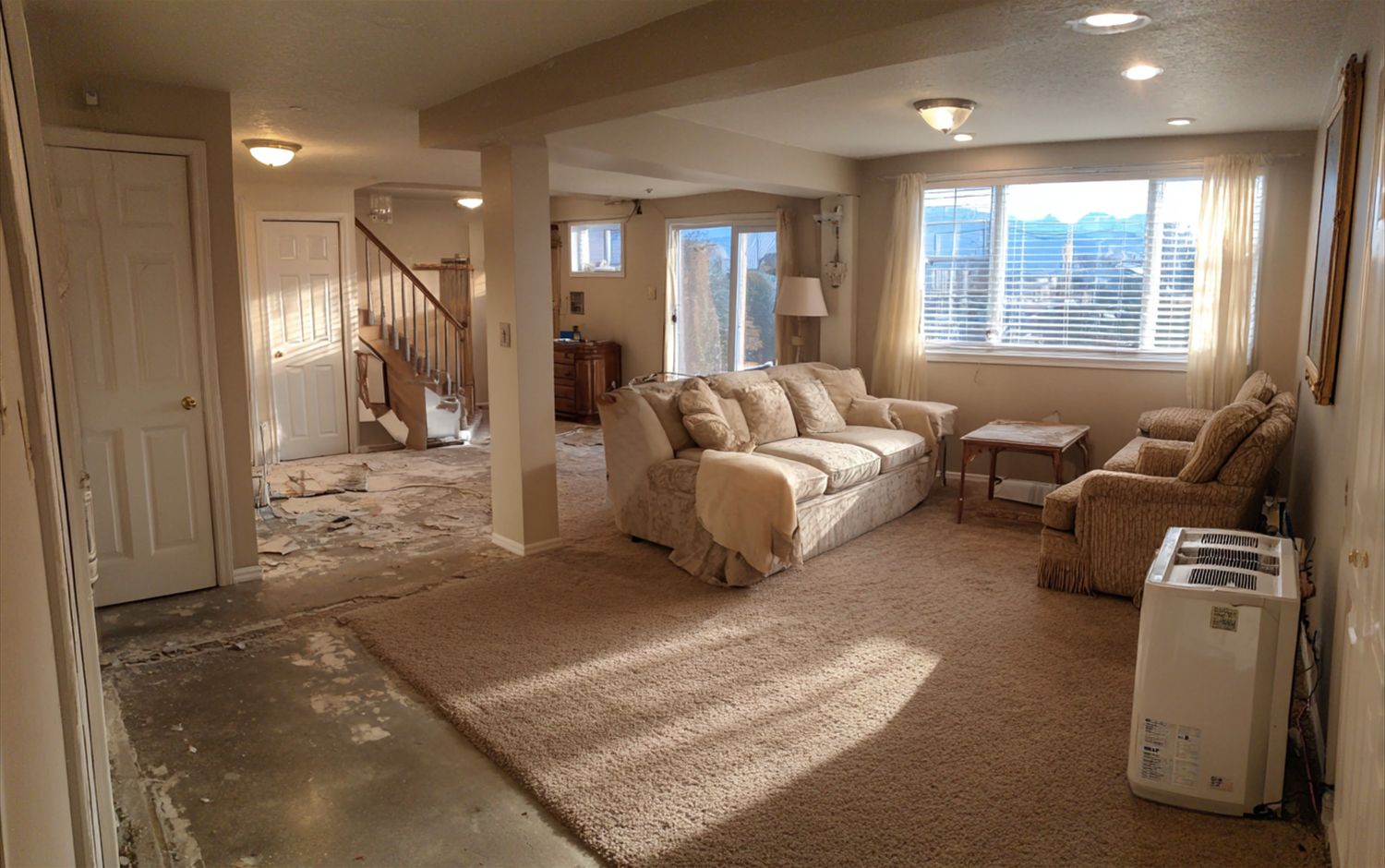
What Restoration Covers in a West Jordan House
Water damage restoration covers the job from the first shutoff to the last coat of paint: stop the water, remove it, dry the building to measured numbers, take out whatever can't recover, and build back what was removed. In a typical West Jordan house that touches more than one level. A leak on the main floor runs through the joists into the basement ceiling; water from outside arrives at the lowest point and spreads across the slab. The company maps every wet area before deciding what stays. For water damage restoration in West Jordan or a neighboring city, dial (385) 318-3819.
Source: the origin of the water sets the cleaning standard. A supply-line leak is clean and often dries in place. Canal water, street runoff and storm water count as outside water, and more of what they touched is removed.
A West Jordan restoration job usually runs in this order:
- Survey. Meters, and often an infrared camera, trace the water across the upstairs subfloor, inside wall cavities and under basement carpet. The edges get marked.
- Water out. Extractors remove standing water and draw it from pad and carpet backing; a truck-mounted unit handles whole basements.
- Tear-out. Soaked pad, swollen baseboard, wet insulation and the bottom of drywall that wicked water come out. In finished basements that often means a strip along every wet wall.
- Drying. Equipment runs until each wet material reads the same as its dry twin in another room.
- Build-back. Insulation, drywall, texture, paint, flooring, doors and trim are replaced.
Restoration, Mitigation and Repair
Websites blur these three. On a written scope they're distinct:
| Word on the scope | What it pays for | Timing |
|---|---|---|
| Mitigation | Water out, wet materials out, equipment and readings | Days one through about five |
| Repair | Rebuilding what the mitigation crew removed | Once dry readings are confirmed |
| Restoration | Mitigation and repair managed together | The whole project |
If every line on the paperwork is equipment days and labor for drying, it's a mitigation scope regardless of its title. More on the first half: water mitigation and drying.
The Finished Basement Is the Expensive Floor
In West Jordan, the basement usually holds the most finished square footage that water can reach. Bedrooms, a family room, a bathroom, sometimes a kitchenette or a full apartment. All of it sits on a concrete slab with carpet and pad, and all of it is the first place water collects.
What that means for the job:
- Carpet and pad on concrete. Pad that soaked up water almost always comes out. Carpet can sometimes be dried and relaid if the water was clean and the response was quick.
- Drywall at the bottom of every wet wall. Basement walls are often framed against concrete with insulation behind. Cutting the lower foot or two lets the cavity dry.
- Egress bedrooms. Basement bedrooms need their egress windows and wells clear and working; if a well flooded, the window and its seals get checked too.
- Furnace rooms. The water heater, softener and furnace often share a room with a floor drain. Water around the furnace base means a technician should check it before it runs again.
Source: basement water that came through a window well or along the foundation usually has an outside cause that will happen again. Ask the company to note where it entered.
Choosing a Company
Before anyone opens a wall:
- Check the license. Utah contractors are licensed through the Division of Professional Licensing (DOPL). Look the company up and confirm the license is active and covers the work.
- Get the scope in writing. It should separate mitigation from repair, list the rooms and materials, and say how drying will be measured.
- Ask how readings are recorded, and whether you'll get a copy of each visit's numbers.
- Ask who does the rebuild. Some restoration companies rebuild; others hand off to a general contractor. Know how the handoff works.
- Read anything that assigns your insurance claim before you sign it.
Permits and the Rebuild
Most of a basement rebuild is cosmetic and doesn't need a permit, but some of it does. Replacing drywall, paint and carpet generally doesn't. Moving walls, changing plumbing, replacing a water heater, rewiring, or altering an egress window usually does, and West Jordan's building division handles permits inside the city. Basement bedrooms also have to keep a working egress window and well after the rebuild. Ask the company or contractor who pulls any permits and who schedules the inspections, and keep the paperwork; it matters when you sell.
What Moves the Cost
This site doesn't set or name prices. These are the things that change the number on a West Jordan job:
- How many rooms and levels the water reached
- Whether the water was clean or came from outside
- How long it sat before extraction started
- How much finished basement had to be opened up
- Carpet and pad replacement versus drying in place
- How many days the equipment runs
- Matching finishes in the rebuild
- Any appliance or system repairs, such as a water heater or furnace, which are separate work
How Long It Usually Takes
Drying a clean-water loss usually takes three to five days; the rebuild takes longer. West Jordan's dry air helps, but concrete slabs and framing against foundation walls give up water slowly. After drying is confirmed, the rebuild depends on what was removed: a few days for drywall and paint in one room, several weeks when a whole finished basement comes back with new carpet, trim and doors.
Most families keep living upstairs while a basement is dried. The equipment is loud and runs day and night, so plan for a few noisy nights.
Source: if the loss came from outside, the drying can't finish until the cause is dealt with, whether that's a canal company, the city or a grading problem in the yard.
Can a Flooded Basement Be Saved Without Tearing Everything Out?
Often more than people expect. Clean water pulled out within hours can leave framing and sometimes drywall intact. Outside water, or water that sat for days, usually means more removal.
Does Insurance Cover Water Damage Restoration?
Policies usually cover sudden water from inside the house, like a burst pipe, and often exclude flooding from outside. Canal and main-break situations depend on the cause. Read your policy and talk to your agent early.
Restoration Around West Jordan
In West Jordan
- City CenterIn West Jordan
- Jordan OaksIn West Jordan
- Shadow MountainIn West Jordan
- Oquirrh ShadowsIn West Jordan
- Jordan HillsIn West Jordan
- Cobble CreekIn West Jordan
- EdenbrookeIn West Jordan
- Copper HillsIn West Jordan
Next door, north: Taylorsville · West Valley City · Kearns · Murray · Midvale
Next door, south: South Jordan · Riverton · Herriman · Bluffdale · Sandy