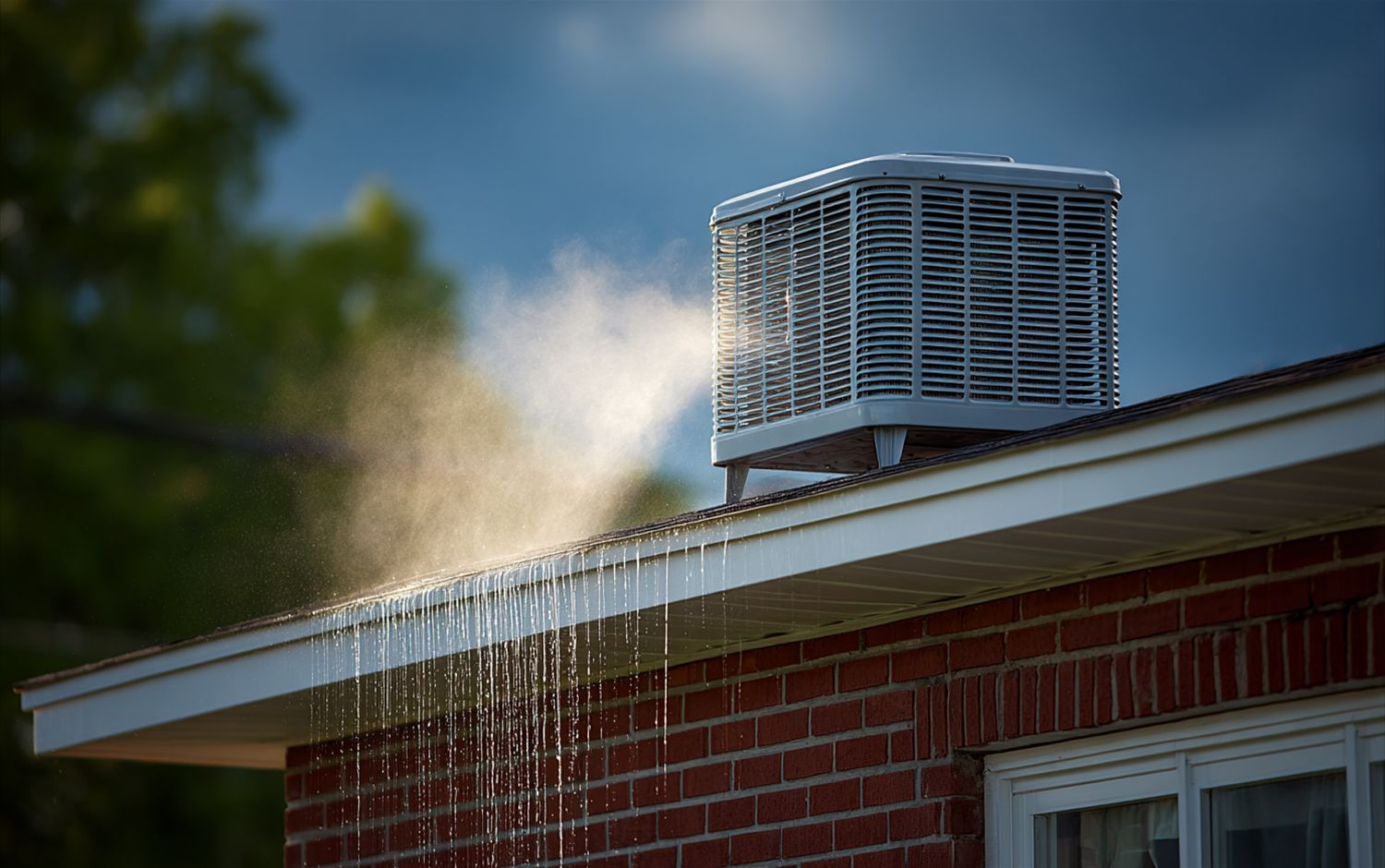
Source: an evaporative cooler, the "swamp cooler" on the roof or in a window, whose water supply, reservoir pan or float valve fails. Water runs onto the roof, into the duct below, or straight through the ceiling it sits on.
Why So Many Utah Homes Have Them
Evaporative coolers work best in dry air, and the Salt Lake Valley has plenty of it. Many West Jordan-area homes built from the 1960s through the 1990s still have a cooler on the roof, sometimes alongside central air. A cooler pulls outside air through wet pads and pushes the cooled air down a duct into the house. To do that, it needs a constant water supply, a reservoir pan, a float valve to keep the level right, and a pump.
Each part can leak, and the cooler sits directly over a ceiling.
What Fails
| Part | Problem | Where the water goes |
|---|---|---|
| Supply line | Cracks, often from freezing if not drained for winter | Onto the roof, sometimes under the shingles |
| Float valve | Sticks open, overfilling the pan | Over the pan's edge into the duct or onto the roof |
| Reservoir pan | Rusts through with age | Straight down into the roof and the duct |
| Bleed-off or overflow line | Clogs with mineral scale | Backs up and overflows |
| Roof jack or curb seal | Fails around the duct opening | Into the attic and the ceiling below |
Source: cooler leaks often show up as a stain around the ceiling vent where cool air comes in, usually in a hallway or main room.
What the Water Damages
- The ceiling drywall around the supply vent, which can sag if it soaks
- Attic insulation around the duct, which compresses and holds water
- Walls and floors below if the leak runs long
- The basement ceiling if water travels down through the floor
The First Hour
- Turn off the cooler and its water supply. The supply valve is often in the basement or near the water heater.
- Keep everyone out from under a sagging ceiling, and turn off lights in that room.
- Catch drips with buckets; don't puncture a sagging ceiling yourself.
- Photograph the stain, the vent and anything visible from the attic access.
- Call to get the ceiling and attic checked and dried. The cooler itself is serviced by whoever you choose.
Drying After a Cooler Leak
Wet attic insulation usually comes out. Ceiling drywall that sagged or stayed wet is cut out; drywall that stayed firm may be dried in place. The company measures the ceiling and the framing around the vent until the readings match dry areas. If water reached the floors and basement, those are dried too. More: water mitigation and drying.
Seasonal Habits That Prevent Leaks
- In fall, shut off the cooler's water supply, drain the line and the pan, and cover the unit.
- In spring, check the pan for rust, the float valve for sticking and the lines for cracks before turning it on.
- Clear mineral scale from the pan and the bleed line; hard water builds it up quickly.
- Check the roof curb seal around the cooler each year.
Around the Valley
1970s–90s neighborhoods in Sandy, Taylorsville and Kearns still have plenty of roof coolers. In West Jordan, older blocks near City Center do too.
EPA WaterSense leak-checking tips
Coolers and Central Air Together
Many homes that kept their roof cooler later added central air conditioning, and some run both. That means two systems with their own water: the cooler with its supply line and pan on the roof, and the air conditioner's condensate line inside, usually near the furnace in the basement. A stain on a main-floor ceiling under the cooler points to the roof; water around the furnace in summer points to the AC's condensate line. If the cooler is no longer used, having its water line capped and the roof opening sealed removes one source of leaks for good.
Signs a Cooler Is About to Leak
A few signs show up before a leak does: rust streaks running down the cooler's sides, mineral crust around the float valve, water dripping from the cabinet seams while the unit runs, or a ceiling vent that sweats in hot weather. A water bill that climbs during cooler season can point to an overflow running to the roof. Any of these is a reason to have the unit looked at before the next hot spell.
Questions
Why did my cooler leak in the spring?
Usually because the line or pan froze over winter. Draining it in fall prevents most spring leaks.
Is a stain around the cooler vent always the cooler?
Usually, but it can also be roof damage near the curb or condensation in the duct. The company can tell from where the moisture is.
Should I keep using the cooler after a leak?
Not until it's repaired and the ceiling is dry.
Frozen Pipes and Sprinkler Systems in a Wasatch Cold Snap
What splits in the cold and leaks at the thaw.
Split-Entry and Rambler Basements: How 1970s–90s Houses Handle Water
Half-buried windows, block walls and older plumbing.